

Last Updated: November 19, 2026
Quick Summary
To diagnose a faulty ECU, first check the battery, ECU fuse, main relay, power and ground at the ECU connector, and connector pins with a multimeter before condemning the module. A faulty ECU cannot be proven by symptoms or a no-communication scan-tool result alone, since bad relays, grounds, and network faults mimic it.
- A healthy, fully charged 12-volt battery typically rests around 12.6 volts; 12.0 volts or lower means discharged.
- A ground voltage drop above roughly 0.1 volt under load means the ground path has resistance.
- A healthy unpowered CAN bus commonly reads near 60 ohms between CAN high and CAN low.
- Swap the ECM relay with a known-good one before condemning the ECU.
- Stop testing once good power, good ground, and a clean network are confirmed but the ECU still fails.
Table of Contents
- Common Symptoms of a Faulty ECU
- How to Test an ECU with a Multimeter
- Symptoms of a Bad ECM Relay vs. a Bad ECU
- Reading Scan-Tool Results and No-Communication Faults
- Differential Diagnosis: Sensors, Immobilizers, and CAN Bus
- Can a Faulty ECU Be Repaired?
- When to Stop Testing and Call a Module Specialist
- Frequently Asked Questions
Common Symptoms of a Faulty ECU
A faulty ECU is one of the most over-blamed parts on any vehicle. The engine control unit, often called the ECM, runs the engine management system, and when it acts up the symptoms look almost identical to a dozen cheaper problems.
Here are the warning signs that actually point toward the computer, and the ones that usually don't:
- No-start condition where the engine cranks fine but never fires
- Intermittent starting or random stalling once the engine warms up
- Check-engine light that stays on, flashes, or refuses to reset
- Loss of communication when a scan tool tries to talk to the ECU
- Misfires and rough running that no tune-up fixes
- Poor fuel economy or a fuel pump that won't prime
- Memory or checksum errors stored in the module itself
Notice what's missing from that list: any single symptom on its own. A no-start or a dead scan tool connection does not prove the ECU is bad. As the diagnostic community behind this ECU no-communication case study points out, those results only raise the question of whether the ECU is at fault or something else is.
How to Test an ECU with a Multimeter
A multimeter can confirm whether the ECU is receiving power and ground, but it cannot test the computer's logic, memory, or injector drivers. That split is the whole point of this section: most "dead ECU" diagnoses fail at the power stage, and a meter is the right tool to prove or eliminate that stage before anyone spends money on a module.
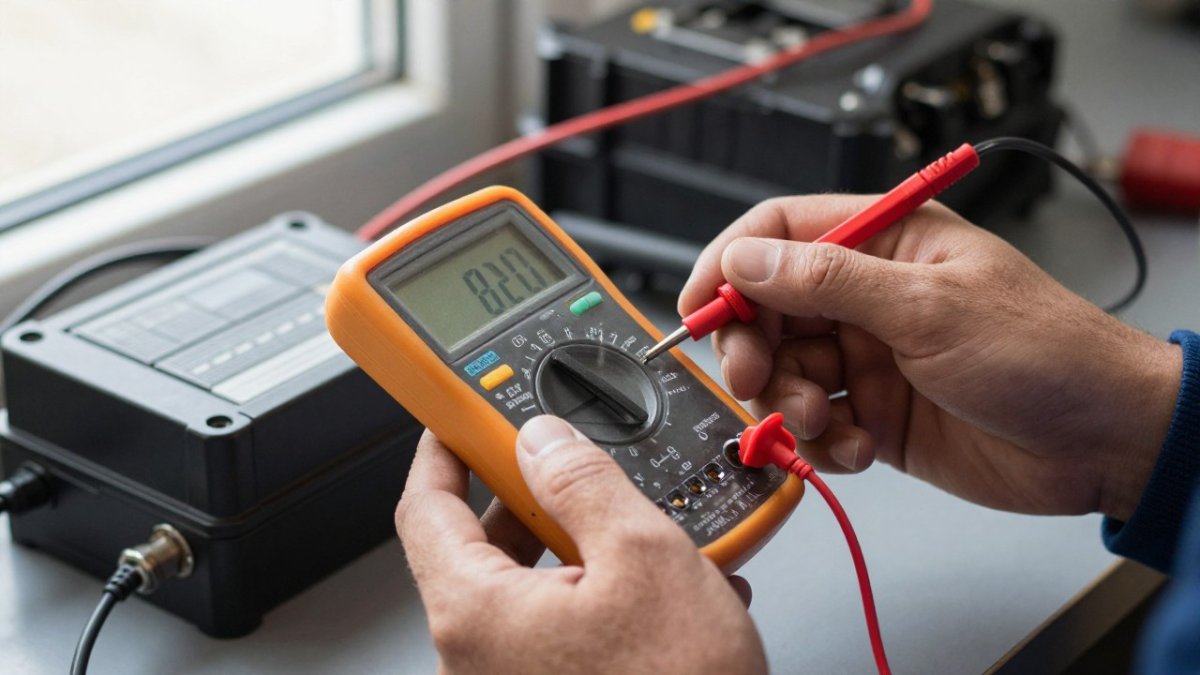
Work through these steps in order, and do not skip ahead:
- Check the battery first. Measure resting voltage at the battery posts. A healthy, fully charged 12-volt battery typically rests around 12.6 volts; a reading near 12.0 volts or lower means the battery is discharged and can cause false no-start and communication faults. Load-test it or charge it before continuing.
- Test the ECU fuse with the meter set to continuity, and confirm the fuse is seated. A fuse that looks good but has a hairline crack will pass a visual check and fail under load.
- Probe the main relay and confirm it clicks and passes voltage to the ECU feed. Swap it with a known-good relay of the same part number before you test further.
- Measure power at the ECU connector with the key on. Back-probe the power feeds at the harness, not the module pins, and look for battery voltage, not something close to it.
- Check ground resistance from the ECU case and from the ground pins in the connector to the battery negative. A ground circuit with visible resistance is a wiring fault, not an ECU failure.
- Inspect the connector pins for corrosion, pushed-back terminals, or green crust. A damaged connector or a pin that has backed out of its housing will kill communication and mimic a dead module every time.
Checking Power, Ground, and Connector Pins
Set your meter to DC volts and back-probe the power feeds at the ECU harness with the ignition on. Then switch to resistance and check each ground circuit. For a more reliable ground test, use a voltage-drop method: connect the meter between the ECU ground pin and the battery negative, crank or load the circuit, and watch for a reading above roughly 0.1 volt.
Watch out: never probe the ECU connector pins from the face side with a standard meter probe. A probe that is too thick spreads the terminal and creates the intermittent fault you are trying to find. Use a back-probe kit or a mating terminal, and disconnect the battery negative before unplugging or reconnecting the module.
What a Multimeter Can and Cannot Prove
A multimeter proves voltage, ground, and continuity. It cannot prove the ECU's internal processor, memory, or injector drivers are working, and it cannot test the logic that decides when to fire a coil or pulse an injector.
That is also where model-specific limits appear. Pinouts, connector shapes, and the number of power and ground circuits vary by vehicle, and a procedure that works on one platform can damage another. Use the service information for the vehicle in front of you, and stop when the next step requires a wiring diagram or an OEM-level tool you do not have.
Work through these checks in order before condemning the module.
| Step | What to do | Key reading or note |
|---|---|---|
| 1 | Check battery resting voltage | About 12.6 volts healthy; 12.0 or lower is discharged |
| 2 | Test ECU fuse with continuity | Confirm fuse is seated; hairline cracks pass visual checks |
| 3 | Probe main relay | Confirm it clicks and passes voltage; swap with known-good relay |
| 4 | Measure power at ECU connector | Key on, back-probe harness, look for battery voltage |
| 5 | Check ground resistance | ECU case and connector ground pins to battery negative |
| 6 | Inspect connector pins | Look for corrosion, pushed-back terminals, green crust |
Symptoms of a Bad ECM Relay vs. a Bad ECU
A bad ECM relay and a bad ECU produce nearly identical symptoms, and the relay is far cheaper to rule out. The relay is the switch that feeds power to the computer; when its contacts wear out, the ECU goes dark intermittently. Classic relay signs include a no-start that comes and goes, a car that dies over bumps, and a module that "wakes up" after you jiggle the fuse box. A failing ECU tends to show steadier problems, like a persistent check-engine light with stored memory or checksum errors. Swap the relay with a known-good one before you condemn anything.
Signs & Symptoms of a Failing ECU/ECM! (Engine Control Unit or Engine Control Module)
8020 Automotive
Reading Scan-Tool Results and No-Communication Faults
A scan tool is a communication device first and a code reader second. When it reports "no communication" with the ECU, that result means the tool could not complete a request-and-response exchange over the vehicle network.
Work the communication path in this order before you touch the ECU:
- Confirm the tool is powered and configured. Plug in the scanner and verify it boots and reads the vehicle's protocol. A tool that never powers up points at the DLC power and ground pins, not the ECU.
- Check the DLC pins. Pins 4 and 5 are chassis and signal ground; pin 16 is battery positive. Back-probe them with the key on. If pin 16 is dead, find the fuse that feeds the DLC before you go any further.
- Test the CAN bus at the DLC. With the key on and the tool disconnected, measure resistance between CAN high (pin 6) and CAN low (pin 14). A healthy, unpowered bus commonly reads near 60 ohms because two 120-ohm terminating resistors sit in parallel. A reading near 120 ohms suggests one terminator or an open leg; a reading near 0 ohms suggests a short between the lines.
- Look for modules that dropped offline together. If several unrelated modules stop responding at once, the cause is usually a shared power feed, a shared ground, or a bus fault, not several failed computers.
- Read the codes you can get. Codes stored in other modules often name the module that stopped talking, which narrows the search to one branch of the network.
What the codes do and do not prove matters as much as the no-communication result. A P0600-series code (serial communication link) tells you the ECU lost a conversation with another module; it does not tell you which end failed.
A common pattern is a vehicle that starts and runs fine but refuses to communicate with one module. The scan tool told the truth: the conversation failed. It just did not say who hung up.
Differential Diagnosis: Sensors, Immobilizers, and CAN Bus
Before you blame the ECU, rule out the systems that feed it. A failed crank sensor, a weak fuel pump, a bad relay, or a dirty ground can trigger the same no-start and misfire symptoms. The immobilizer deserves special attention: a security light and a crank-no-start is an anti-theft fault, not an engine computer fault, and the two get confused constantly. Our make-specific anti-theft and module failure guides break down the symptoms by model, and if a security light is your main clue, this step-by-step security light guide walks you through it. Suspect the immobilizer itself? Here's how to reset the immobilizer system to rule it out.
Can a Faulty ECU Be Repaired?
Yes, a faulty ECU can often be repaired rather than replaced, and repair usually costs less than a new module plus programming. Common fixes include reflowing cracked solder joints, replacing failed drivers, and clearing corrupted memory. Repair requires the right equipment and a bench test. If you've confirmed the module is the problem, our mail-in module programming and repair service handles BCM, ECU, and immobilizer modules. We also offer clone modules when a replacement needs to match the original unit's programming.
When to Stop Testing and Call a Module Specialist
Stop testing when you've confirmed good power, good ground, and a clean network, and the ECU still won't communicate or keeps logging memory errors. You can ship the module in for repair and get it back tested and working, or call us for dispatch. If a failed key or fob is part of the picture, we also handle replace keys and offer a No Start Guide to help you sort a crank-no-start quickly.
The hardest part of ECU diagnosis isn't the testing, it's knowing when to stop. If you've ruled out the relay, the grounds, and the network and the module still won't cooperate, don't keep guessing. Dealerkeys offers OEM-level diagnostics, mail-in module repair for BCM, ECU, and immobilizer units, and mobile dispatch seven days a week. Get started with Dealerkeys and get your module tested, repaired, and back on the road.
Frequently Asked Questions
How do I test if my ECU is bad?
Start by checking the basics before blaming the module: battery voltage, fuses, the ECM relay, and the ground connection. Then connect an OBD-II scan tool and confirm whether it communicates with the ECU at all. If communication is lost, inspect the CAN bus wiring and connector pins for damage. A multimeter check of power and ground at the ECU connector comes next. Only when power, ground, and network tests all pass should you suspect the faulty ECU itself.
Will a bad ECU throw a code?
Sometimes, but not always. A failing ECU can set diagnostic trouble codes for internal memory or checksum errors, misfires, or injector signal faults. However, a no-start condition with a complete loss of scan-tool communication often produces no code at all, because the module cannot report on itself. That is why reading codes alone is not enough to confirm ECU failure. Treat codes as one clue in a wider diagnostic workflow that includes relay, wiring, and power-supply checks.
What is the difference between a bad ECU and a bad ECM relay?
Symptoms of a bad ECM relay often mimic ECU failure: no-start, intermittent stalling, and a dead scan tool. The difference is where the fault sits. A relay is a cheap switch that supplies power to the module; if it fails, the ECU gets no voltage and appears dead. Test the relay by swapping it with an identical known-good unit or checking for voltage at the ECU power pin. If power returns and the engine starts, the relay was the problem, not the ECU.
Can a faulty ECU be repaired, or does it need replacement?
Many faulty ECU units can be repaired rather than replaced. Common fixes include reflowing damaged solder joints, replacing failed internal components, and correcting memory or checksum errors. Repair is often faster and less expensive than sourcing and programming a new module, especially for older or rare vehicles. A specialist mail-in repair service can test the unit on a bench, confirm the fault, and restore it to factory specification. Replacement is usually the last resort when the board is physically damaged beyond repair.
 Add dealerkeys.com as a preferred source on Google →