
Quick Summary
A failing motorcycle ignition cylinder usually shows up at the key: it sticks, feels gritty, will not turn past the first position, or will not come out. Wear from repeated use and worn or bent keys speed up the problem. Do not force a stuck key, since it can snap inside the lock.
- Do not force a stuck key, because it can snap off inside the cylinder.
- Watch for dash flicker or power loss, which often points to the switch rather than the cylinder.
- Rule out a weak battery, kill switch, blown fuse or loose connector before replacing the cylinder.
- Do not spray penetrating oil into the cylinder; use the lubricant in your owner's manual.
- Stop riding if the bike shuts off while moving or you smell burning near the ignition.
Table of Contents
- What the Ignition Cylinder Does and Why It Wears Out
- Key Stuck in the Ignition or Hard to Turn
- Motorcycle Ignition Switch Symptoms to Check
- Ignition Cylinder Versus Ignition Coil: How to Tell Them Apart
- Testing the Ignition Coil Before You Replace Anything
- When to Stop Riding and Get It Looked At
- Ignition Cylinder Replacement and Getting Your Bike Back on the Road
- Frequently Asked Questions
What the Ignition Cylinder Does and Why It Wears Out
Last Updated: November 17, 2026
If your motorcycle has a key that turns the bike on and off, the ignition cylinder is the lock doing that job.
A motorcycle ignition cylinder is the keyed lock that turns the bike's power system on.
Ignition cylinders wear out for ordinary reasons. Every time you insert and turn the key, small metal parts rub together.
Cheap or worn keys speed up that wear.
Key Stuck in the Ignition or Hard to Turn
A key that will not turn or will not come out is often the first sign of a failing cylinder.
- The key goes in but will not rotate past the first position.
- The key turns but feels gritty, loose or sticks halfway.
- The key will not pull out of the ignition after you park.
- You have to jiggle or force the key to get any movement.
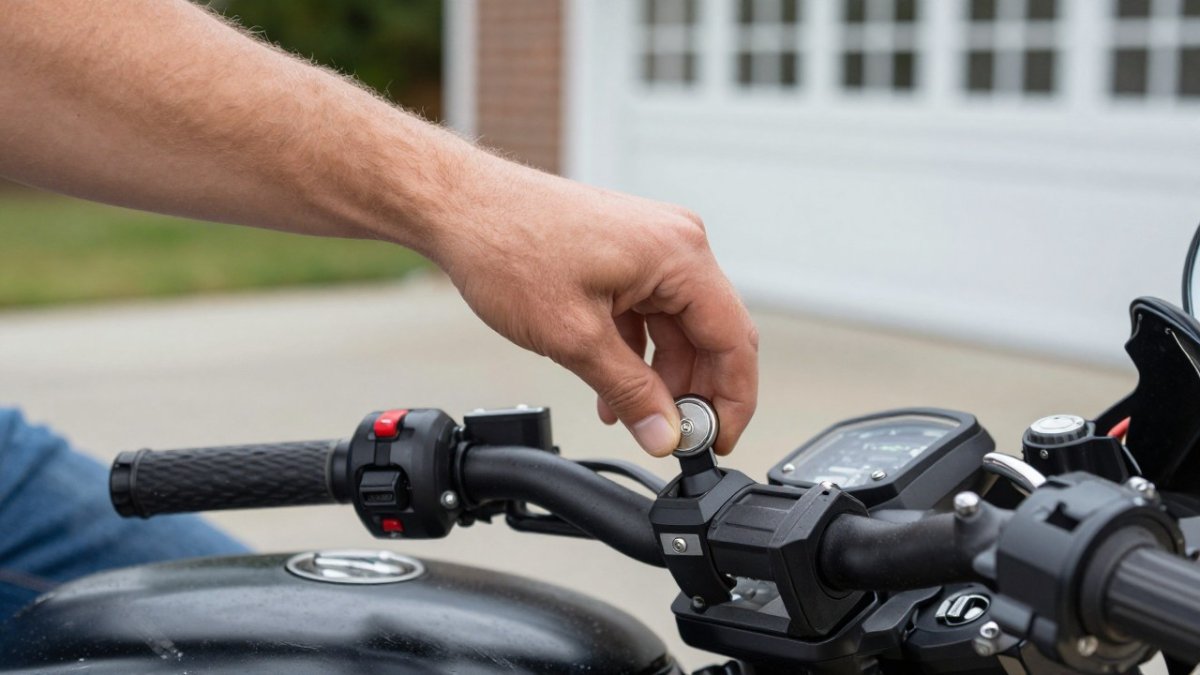
Do not force a stuck key. Forcing it can snap the key off inside the cylinder, which turns a simple repair into a bigger job.
!Close-up of a rider's hand turning a motorcycle key in a handlebar-mounted ignition on a parked bike in a driveway
Motorcycle Ignition Switch Symptoms to Check
The ignition switch and the cylinder work as a team. A bad switch can cause problems that look like a bad cylinder, so note what is happening when the problem shows up.
- The bike has no power at all, even with the key fully turned.
- Lights or the dash flicker when you move the key.
- The bike starts in one key position but not another.
- The key feels loose and the bike shuts off over bumps.
If the symptom only happens when you turn the key, the cylinder or switch is the likely cause. If it happens while riding, suspect wiring or the switch contacts first.
The article lists several symptoms that point to a failing ignition switch or cylinder, and these are the ones to check. For make-specific module failure symptoms and fixes, see the anti-theft and module failure guides.
| Symptom | When it happens | What it suggests |
|---|---|---|
| No power at all | Key fully turned | Switch or power circuit fault |
| Lights or dash flicker | When key is moved | Switch or cylinder contacts |
| Starts in one position only | Specific key position | Switch contact problem |
| Key feels loose, bike shuts off | Over bumps | Loose switch contacts |
| Power cuts out while riding | Mid-ride | Wiring or switch contacts |
Ignition Cylinder Versus Ignition Coil: How to Tell Them Apart
People often mix these two up, and the confusion costs money. The ignition cylinder is the keyed lock. The ignition switch is the electrical contact assembly the cylinder actuates. The ignition coil creates the spark that fires the engine.
A bad cylinder usually shows up at the key: the key sticks, feels gritty, will not rotate past the first position, or will not come out.
Differential Diagnosis: Rule Out the Cheap Suspects First
Before you condemn the cylinder, work through the parts that mimic it. A weak battery, a charging fault, a kill switch left in the wrong position, a side-stand interlock, a blown fuse, or a chafed wiring harness can all produce a no-start or intermittent cutout that looks like a bad ignition cylinder.
- Battery and charging. A battery that cranks slowly or a charging system that is not keeping up can cause hard starting and dash flicker. Check battery voltage at rest and while cranking before you touch the lock.
- Kill switch and side-stand interlock. These are designed to cut ignition. Confirm the kill switch is in the run position and the side stand is up (or the interlock is bypassed per the owner's manual) before diagnosing the cylinder.
- Fuses. A blown ignition or accessory fuse kills power to the switch circuit. Check the fuse box against the label in your owner's manual.
- Wiring and connectors. A loose connector at the back of the switch or a chafed wire in the steering head area can cause intermittent power that mimics a bad cylinder. Wiggle the harness with the key on and watch the dash.
A common pattern is that the cylinder is blamed for a switch or wiring fault. If the key turns smoothly but the dash flickers, the cylinder is probably fine and the switch or its connector is the problem.
Safe Checks You Can Do at Home
Work through these in order. Stop at any step that requires opening live wiring or testing spark, and hand that to a technician.
- Try a known-good spare key. If only one key fails, the key may be worn or bent rather than the cylinder.
- Watch the dash with the key in each position. Note whether lights and the display come on in the run position and go off in the accessory or off position. Flicker when you wiggle the key points to the switch or connector.
- Listen for the relay or fuel-pump prime. Turn the key to run and listen for the click or prime whine. No click with a good battery points to the switch circuit.
- Inspect the lock face. Look for dirt, grit, a loose cylinder, or a key that sits crooked in the slot.
- Check battery voltage at rest. A healthy 12-volt battery should read near 12.6 volts at rest; a reading well below that suggests the battery, not the cylinder.
Watch out: do not spray penetrating oil or lubricant into the cylinder as a first move.
Watch out: never touch a spark plug wire or coil output while the engine is running or the key is on.
Testing the Ignition Coil Before You Replace Anything
Before you buy a new cylinder or coil, confirm which part has failed. Replacing the wrong part wastes money.
Common coil symptoms include:
- Engine misfires, especially under load
- Loss of power or reduced acceleration
- Hard starting or no-start condition
- Stalling or rough running at idle
A coil that fails only when the engine is warm often points to heat-related breakdown. Test the coil with a proper meter or ask a shop to test it for spark.
Many owners of modern bikes also find that module or immobilizer faults mimic coil problems. Dealerkeys offers mail-in repair for BCM, ECU, and immobilizer modules, and you can learn more on its module repair service page.
When to Stop Riding and Get It Looked At
Stop riding and have the bike checked if any of these happen:
- The bike shuts off while moving
- The key will not turn or come out, and you cannot start the bike
- You see sparks, smell burning, or notice melted plastic near the ignition
- The engine misfires badly or loses power at speed
Riding with a failing cylinder or coil can leave you stranded in traffic. A sudden shutdown at speed is a real safety risk. If in doubt, get a tow rather than limping home.
Ignition Cylinder Replacement and Getting Your Bike Back on the Road
Once you know the cylinder has failed, the repair path depends on what actually broke. The cylinder, the electrical switch, and the wiring can often be serviced separately, and knowing which one is at fault keeps the bill down.
- Cylinder only. If the key sticks or will not turn but the electrical switch works, a locksmith may be able to repair or rekey the cylinder rather than replace the whole assembly.
- Switch only. If the key turns smoothly but the dash flickers or the bike cuts out, the electrical switch or its connector is the suspect. The switch can often be replaced without replacing the keyed cylinder.
- Wiring and connectors. A loose or chafed connector at the back of the switch is a common and inexpensive fix. Ask the technician to check it before quoting a cylinder.
- Module or immobilizer. On bikes with an immobilizer, the key, cylinder, and electronic module are matched. Replacing the cylinder may require programming the new key to the module, and some modules must be repaired or replaced rather than reflashed. If your module needs repair, you can have it repaired and shipped back through the mail-in service.
Key and Security Implications
Replacement is not just a mechanical swap on many modern bikes. If your bike has an immobilizer, a new key must be programmed to the module, and the job requires the right equipment. Keep your spare key and any key tag or code card, they speed up the job and can reduce cost. If the key is stuck and you have no spare, these lockout fixes for when you have no spare key cover your options.
What Drives the Cost
Pricing depends on the bike, whether the cylinder, switch, or both are replaced, whether a new key must be cut and programmed, and whether the work is done on-site or the module must be sent out. Pricing depends on the bike and the work required, so check the replacement keys page for current prices or a quote before booking.
Some riders have a dead or lost key too. A no-start guide can help you work through that situation before a technician arrives.
Before You Ride Away
When the cylinder or switch is replaced, test the new key in every position before you ride. Confirm the bike starts, the lights and dash come on in the run position and go off in the off position, the key comes out cleanly, and the steering lock engages and releases.
Dealerkeys works with riders across East Tennessee who need a dependable ignition fix. Call for dispatch and get your bike running again.
Frequently Asked Questions
How can you tell if a motorcycle ignition cylinder is bad?
The most common signs are a key that is hard to insert or turn, a key that gets stuck, a switch that feels loose or does not engage cleanly, and a bike that will not start even though the battery is charged. Intermittent problems often get worse over time, so a cylinder that works on some days and fails on others is a warning sign. If the key turns freely but the bike still does not start, the fault may lie elsewhere, such as the ignition switch, wiring, or the coil. A professional can test the cylinder and switch together to confirm the source before any parts are replaced.
How can I tell the difference between a bad ignition cylinder and a bad ignition coil?
The ignition cylinder controls the key-operated switch that powers the bike, so its problems show up at the lock: the key sticks, binds, or does not turn. The ignition coil produces the spark that fires the engine, so its problems show up in running: misfires, popping, loss of power, or no-start with a working key. If the key operates normally and the bike still misfires, suspect the coil. If the key is difficult and the bike will not power up at all, suspect the cylinder or switch.
Can a bad motorcycle ignition cylinder cause starting problems?
Yes. A worn cylinder can fail to make proper contact with the switch, which cuts power to the ignition circuit and prevents the bike from starting. Some riders notice the dash lights flicker or stay off when the key is turned. Starting problems caused by the cylinder often come and go, which makes them harder to diagnose. Have the cylinder checked before assuming the battery or starter is at fault.
Can I test a motorcycle ignition coil without a multimeter?
A basic check is possible without a multimeter by looking for spark at the spark plug while cranking the engine, using a spark plug tester or a spare plug grounded against the engine. Use caution, since the coil produces high voltage, and keep fuel vapors away from the work area. A steady spark suggests the coil is working. However, a multimeter gives a more reliable reading of coil resistance, so a professional test is the better option if the result is unclear.
 Add dealerkeys.com as a preferred source on Google →