

Table of Contents
- Is Mail-In ECU Repair Safe? The Short Answer
- What an ECU Controls and Why Failures Happen
- Common ECU Failure Symptoms to Confirm First
- How to Ship an ECU for Repair Without Damage
- ECU Repair Turnaround Time and Vehicle Downtime
- ECU Repair Warranty: What a Safe Service Should Guarantee
- ECU Repair vs Replacement: Which Makes Sense
- Data Security, Immobilizer, and Key Programming After Repair
- Frequently Asked Questions
Last Updated: October 21, 2026
Is Mail-In ECU Repair Safe? The Short Answer
Yes, mail-in ECU repair is safe when you choose the right provider and protect the module in transit.
An engine control unit (ECU) is the computer that runs your engine's fuel, ignition, and emissions systems. When it fails, your vehicle may not start or may run poorly.
Below, we break down the exact steps that make mail-in ECU repair safe, from confirming the fault to reinstalling the unit.
Key Takeaway Safety in mail-in repair comes down to three things: a confirmed diagnosis before you ship, antistatic packaging, and a written warranty that covers both the repair and return shipping.What an ECU Controls and Why Failures Happen
The ECU is the brain of your vehicle's electronics. It reads sensors and adjusts fuel, timing, and emissions in real time. It also stores fault codes that a scan tool can read.
Failures usually trace to a handful of causes:
- Heat and vibration breaking down solder joints on the circuit board
- Water intrusion corroding connector pins
- Voltage spikes from a failing battery or alternator
Related modules fail the same way. That includes the ABS control module, airbag control module, body control module, and instrument cluster. Component-level repair can often fix these boards instead of replacing them.
Common ECU Failure Symptoms to Confirm First
Before you mail anything, confirm the ECU is actually the problem. A bad sensor or a loose ground can mimic a failing module.
Watch for these failure symptoms:
- Crank but no start, or a start that cuts out
- Check engine light with codes that point to the ECU itself
- Intermittent fault codes that clear and return
A common mistake is shipping a module when the real fault is a chafed wire or a weak battery. A proper fault diagnosis with a scan tool comes first. Test the battery, check grounds, and read live data before you remove the module.
Watch Out Shipping a healthy ECU wastes time and money. If your scan tool cannot communicate with the module at all, check power and ground at the connector first. A dead circuit looks exactly like a dead ECU.How to Ship an ECU for Repair Without Damage
Safe shipping is not just bubble wrap. It is a chain of controls: antistatic handling, connector protection, cushioning, declared value, carrier insurance, and proof of delivery. Miss one link and a repairable module can arrive dead, or vanish with no reimbursement.
Before the Box: Antistatic and Connector Protection
Static electricity can destroy a circuit board before it reaches the bench. Follow this sequence:
- Disconnect the battery and wait a few minutes before touching any connector.
- Ground yourself. Wear an antistatic wrist strap clipped to bare metal, or touch a bare metal surface before handling the module. Avoid carpet, synthetic clothing, and dry winter air, which build static fast.
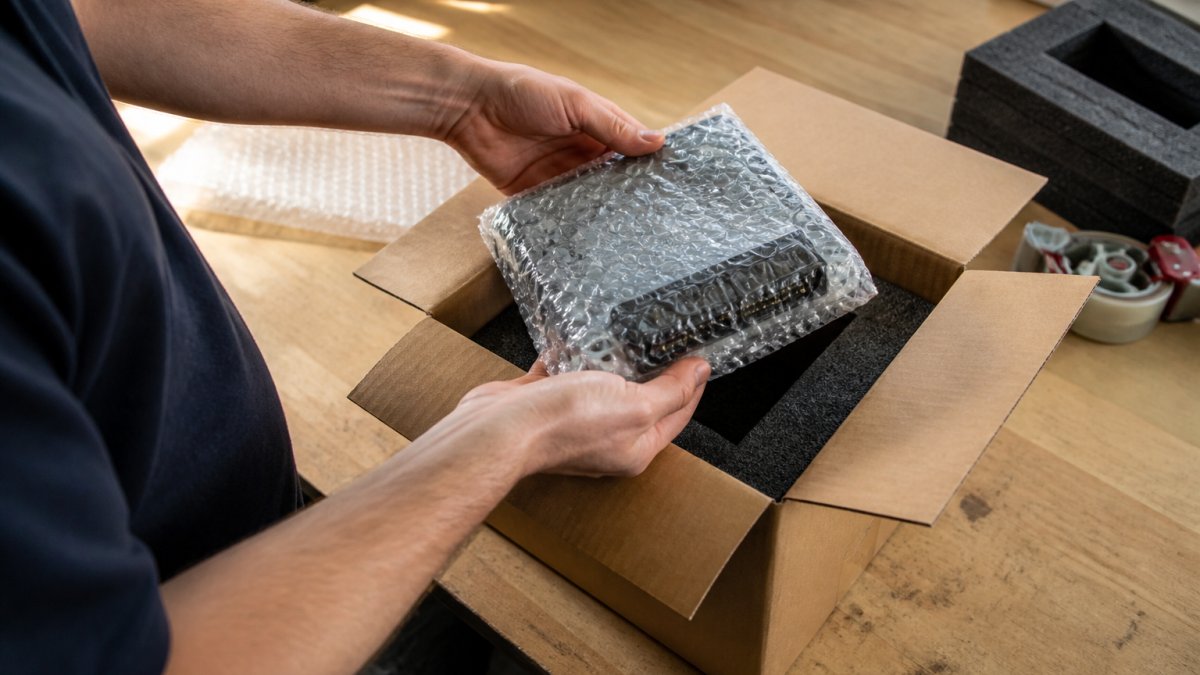
- Bag the module in an antistatic bag. Never use plain plastic wrap, which traps static, and never ship a bare board loose in a cardboard box.
- Protect the connector pins. Reinstall the connector shell or wrap the connector face in antistatic foam so pins cannot bend. Bent pins are one of the most common shipping failures and can prevent the module from seating on reinstall.
- Bag and label mounting hardware with the module so nothing is lost.
Cushioning and Box Construction
- Wrap the bagged module in at least two inches of bubble wrap on every side.
- Set it in a sturdy corrugated box with foam padding so the module cannot shift.
- Fill all empty space; shake the closed box and confirm nothing moves.
A common pattern is a module that tests fine at the shop but arrives with a cracked board because it shifted inside a single-wall box. Double-boxing, a padded inner box inside a larger outer box, is the standard defense for high-value modules.
Declared Value, Insurance, and Tracking
Packaging protects against shock; insurance protects against loss. Do both.
- Declare the full replacement value on the shipping label. Carriers cap liability for undeclared or undervalued shipments, so a $1,200 module declared at $100 is reimbursed at $100.
- Buy carrier insurance or use a service tier that includes it. Ask the repair shop whether return shipping is insured and at what declared value.
- Use tracked, signature-required service so delivery is documented. Keep the tracking number, receipt, and photos of the packed box.
Removal Notes That Affect Shipping Safety
- Release connector lock tabs by hand, never with a screwdriver.
- Inspect connector pins for corrosion or bending before shipping and photograph them.
- Photograph the connectors and mounting points before removal so reinstall is exact.
ECU Repair Turnaround Time and Vehicle Downtime
Turnaround time is the number every owner asks about first. A typical mail-in service includes shipping to the shop, bench testing, the repair itself, and return shipping.
Plan for vehicle downtime in stages:
| Stage | What Happens | What to Plan For |
|---|---|---|
| Outbound shipping | You ship the packed module | 2-5 business days |
| Bench testing | Shop confirms the fault | 1-3 business days |
| Repair | Component-level fix on the board | 1-5 business days |
| Return shipping | Module shipped back to you | 2-5 business days |
Ask the provider for a realistic turnaround time before you ship. A shop that quotes an exact number without testing first is guessing. Build in a buffer if you depend on the vehicle daily.
Pro Tip Photograph the tracking number and keep the receipt. If a shipment goes missing, that record is what starts a claim with the carrier.ECU Repair Warranty: What a Safe Service Should Guarantee
A warranty is only as good as the terms behind it. Before you ship a module, verify the provider on five points: diagnostic capability, written warranty terms, data handling, insurance, and return-shipping procedure. A shop that answers all five in writing is a safe bet; one that hedges is not.
The Five-Point Provider Safety Checklist
- Diagnostic capability. Ask what bench equipment the shop uses to test the module before and after repair, and whether you receive a written test report. A shop that repairs without a documented pre- and post-repair test is guessing.
- Written warranty terms. Get the warranty period, what it covers (the repaired component, not just labor), and the remedy, repair, replacement, or refund, in writing before you pay.
- Data handling. Confirm the shop does not copy, retain, or alter your immobilizer or security data beyond what the repair requires, and ask how data is stored and destroyed.
What the Warranty Should Cover
Look for these terms in writing:
- A stated warranty period on the repair
- Coverage for the repaired component, not just labor
- A clear policy if the module proves unrepairable
- Return shipping included or clearly priced
If the Module Is Unrepairable, Damaged, or Lost
Set expectations before you ship, not after something goes wrong.
- Unrepairable module. A reputable shop tests first and tells you before charging for a repair it cannot complete. Ask whether a diagnostic fee applies if the module is beyond repair, and whether the module is returned or scrapped.
- Damaged in transit. If the module arrives damaged, the carrier claim and the shop's insurance should cover it. That is why declared value and shipping photos matter. Ask the shop who files the claim and how reimbursement reaches you.
- Lost in transit. Tracked, signature-required shipping plus declared value is the only reliable path to reimbursement. Keep the tracking record and receipt.
- Escalation. Ask for the shop's written escalation path, who you contact, in what timeframe, and what remedy applies, before you send the module.
Repair vs. Replacement and the Warranty Trade-off
A dealer replacement typically carries a parts warranty but requires a new module plus programming to your vehicle identification, which adds cost and time. Component-level repair keeps your original module and often costs less for board-level faults, but the warranty is only as strong as the shop behind it. Weigh the warranty terms, not just the price, when choosing between the two.
ECU Repair vs Replacement: Which Makes Sense
Repair usually wins when the fault is a bad solder joint or a single failed component. Replacement makes more sense when the board is cracked, water-damaged beyond repair, or the module is no longer supported.
Here is the trade-off in plain terms:
| Factor | Repair | Replacement |
|---|---|---|
| Cost | Lower for board-level faults | Higher, especially at a dealer |
| Downtime | Depends on shipping | Depends on part availability |
| Vehicle compatibility | Keeps your original module | Needs programming to the VIN |
| Best for | Solder, component, and pin faults | Cracked or unsupported boards |
A dealer replacement often requires a new module plus programming to your vehicle identification. That adds cost and time. For many owners, component-level repair is the better call when the board is fixable.
Data Security, Immobilizer, and Key Programming After Repair
Your ECU holds security data tied to the immobilizer system. That is why key programming and module work belong with a shop that uses OEM-level tools.
Ask two questions before you ship:
- How is my data handled? The shop should confirm it does not alter or copy your security data beyond the repair.
- Will the immobilizer still recognize my keys? Some repairs require a relearn or key programming after reinstall.
A module that comes back working but out of sync with the immobilizer will not start the car.
If your vehicle will not start after reinstall, check our No Start Guide before you assume the module failed again.
Frequently Asked Questions
Can an ECU be damaged during shipping?
Yes. Transit damage is the biggest risk in mail-in ECU repair, and it usually comes from three things: static discharge, loose connector pins bending against the box, and poor padding that lets the circuit board flex. Pack the module in an antistatic bag, wrap it in at least two inches of bubble wrap or foam, and use a sturdy box with no empty space. Keep the tracking number and consider shipping insurance, since a lost or crushed shipment can turn a repairable fault into a replacement job.
How long does mail-in ECU repair take?
ECU repair turnaround time depends on the provider and the fault. A typical flow is one to three business days for shipping each way, plus bench testing and component-level repair once the module arrives. Ask for a quoted turnaround before you ship and confirm whether the clock starts at delivery or at diagnosis. If your vehicle is your only transport, plan for vehicle downtime and ask whether the provider offers expedited handling or a tested exchange unit.
What should I check before choosing an ECU repair service?
Confirm four things: a written repair warranty that covers the repaired fault, a bench test report before and after repair, a clear policy for unrepairable or transit-damaged modules, and whether immobilizer or key programming is included after the ECU is reinstalled. Also ask how they handle vehicle identification and compatibility, since a mismatched module can leave the vehicle in a no-start state. A provider that answers these plainly is a safer bet than one quoting only a low price.
Is ECU repair cheaper than dealer replacement?
Component-level repair usually costs less than a dealer replacement, which often means a new module plus programming and immobilizer pairing at shop rates. The trade-off is time: repair means shipping and downtime, while replacement may be faster if the part is in stock. Weigh ECU repair vs replacement by fault type. Solder joint and component failures on the circuit board are good repair candidates; physical damage or water intrusion often pushes toward replacement.
Mail-in ECU repair carries real risk, but most of it comes from packaging and provider choice, not the repair itself. Dealerkeys offers a streamlined mail-in repair process for ECU, BCM, and immobilizer modules, backed by 26+ years of experience and OEM-level tools. We also handle module cloning and key programming so your vehicle starts on the first try. Call Dealerkeys for dispatch and get your module tested, repaired, and returned to factory specs.
Call for dispatch