
Last Updated: October 30, 2026
Quick Summary
To test a key fob signal, first replace the battery and clean its contacts, then press lock and unlock while standing beside the car. Next, test range at measured distances and rule out interference in an open area. Finally, compare results with a spare fob and an RF signal tester.
- Most fob failures come from a weak battery, so replace it before anything else.
- Use one button and test at 10, 20 and 30 feet, repeating each distance three times.
- A blank phone-camera screen proves nothing for radio-frequency fobs, which cannot be seen by a camera.
- Test the fob in an open area to rule out interference from metal, power lines or buildings.
- If a spare fob works and the first does not, the original fob is the problem.
Table of Contents
- Why Your Key Fob Signal Stops Working
- Step 1: Check the Fob Battery and Contacts
- Step 2: Test Button Presses and Response From the Car
- Step 3: Test Range and Signal Near the Vehicle
- Step 4: Rule Out Interference in an Open Area
- Step 5: Use a Key Fob Signal Tester or Phone Camera Check
- Step 6: Compare Results With a Second Fob and Inspect for Damage
- Step 7: Diagnose a Fob Still Not Working After Battery Replacement
- Frequently Asked Questions
Why Your Key Fob Signal Stops Working
A key fob that stops working is frustrating, but the cause is often simple. Before you assume the fob is dead, you can test its signal in a few quick steps. The first checks below resolve many common fob problems before a professional visit is needed.
A key fob signal is the radio or infrared message the fob sends to the car when you press a button. The car's receiver reads that message and then locks, unlocks or starts the vehicle. When any link in that chain breaks, the fob seems dead even when it is not.
Common causes include:
- A weak or dying battery
- Dirty or corroded battery contacts
- Worn or stuck buttons
- Physical damage from drops or water
- Interference from nearby signals or metal objects
- A fault in the car's receiver or electronic modules
Work through the steps in order. Each one rules out a common cause before you move to the more involved checks.
Step 1: Check the Fob Battery and Contacts
Start with the battery. Most fob failures come from a weak battery, not a broken fob. Open the fob with a small flat tool, look at the battery type printed on it, and check the contacts for white or green corrosion.
- Replace the battery with a fresh one of the correct type.
- Confirm the positive side faces the right way.
- Wipe the contacts with a dry cloth or a cotton swab.
Watch out: Do not pry hard at the seam. A cracked case lets moisture in and creates a new problem.
Step 2: Test Button Presses and Response From the Car
Stand next to the car and press the lock button once. Listen for the locks and watch for the parking lights or hazard flash. Then press unlock.
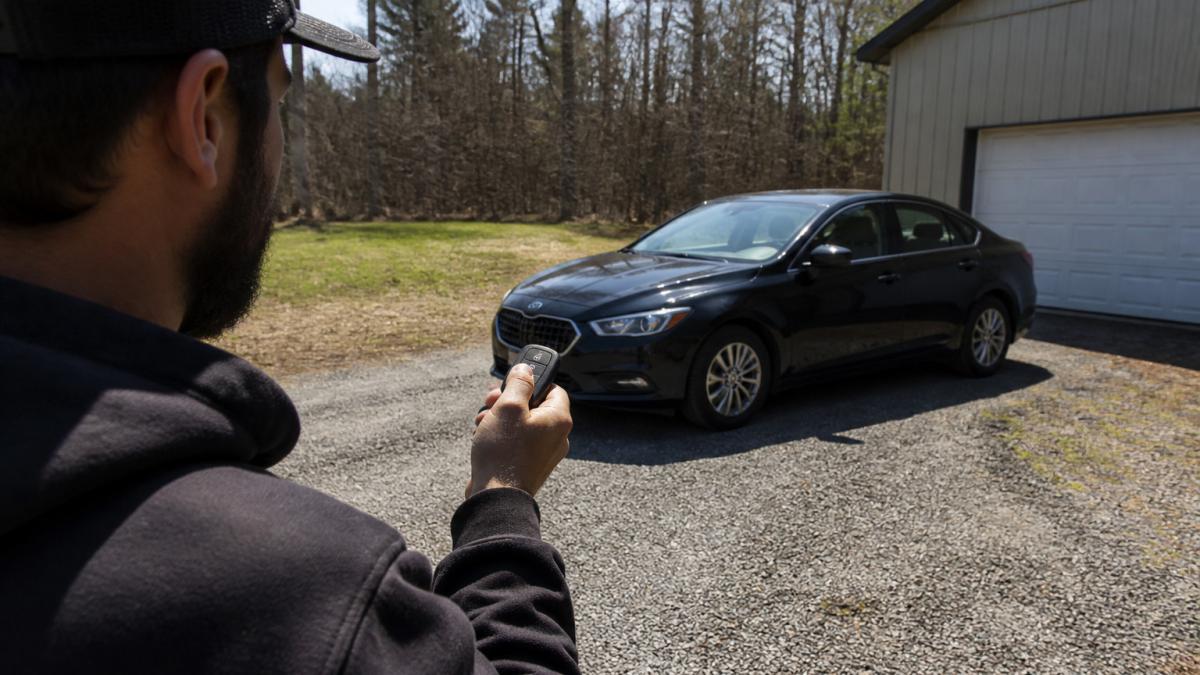
If the car responds, the fob and receiver are both talking. If nothing happens, press the button a few times and try each function, since a single weak press may not register.
!A person in a gravel driveway pressing the lock button on a car key fob while standing a few feet from a parked sedan in daylight
Keep a simple log of what you tried and what happened. This record helps if you call a professional later.
Step 3: Test Range and Signal Near the Vehicle
Range testing is only useful if you can repeat it. A fob that works "sometimes" usually works at a consistent distance under consistent conditions, so the goal is to remove variables and find that distance.
Set up a repeatable test:
- Pick one button, usually lock, and use only that button for the whole test.
- Hold the fob the same way each time, with the buttons facing the car and nothing covering the fob.
- Stand on the same side of the vehicle, ideally the driver's door, and walk straight back.
- Test at measured marks: touching the door handle, 10 feet, 20 feet, and 30 feet. A tape measure or a few paced steps is enough.
- Repeat each distance three times and record how many of the three presses worked.
That last step matters. A fob that works two out of three times at 20 feet is behaving differently from one that works zero out of three, and the pattern points to different causes.
Now read the result against this map:
- Works only within a foot or two of the car: the fob is transmitting but weakly. A tired battery, dirty contacts, or a failing transmitter are the usual suspects. Replace the battery first, then retest before condemning the fob.
- Works at close range but drops off well short of normal: the fob signal is weak or the vehicle's receiver antenna is degraded. Compare with a spare fob, if the spare reaches normal distance, the first fob is the problem; if both fall short, suspect the vehicle antenna or receiver.
- Works at full distance sometimes and not others: interference or an intermittent contact inside the fob. Repeat the test in an open area (Step 4) to separate the two.
- Fails at every distance, including against the door: this is not a range problem. Go back to the battery and button checks before assuming a receiver fault.
Write down the distances and the pass counts. That record is what lets a technician, or you, tell a weak fob apart from a weak receiver without guessing.
Use this map to read the range test results and narrow down the likely cause.
| Range result | Likely cause | Next action |
|---|---|---|
| Works only within a foot or two | Weak transmission: battery, contacts or transmitter | Replace battery, then retest |
| Short of normal range at close distance | Weak fob or degraded vehicle antenna | Compare with a spare fob |
| Works at full distance sometimes | Interference or intermittent contact | Repeat test in an open area |
| Fails at every distance, including the door | Not a range problem | Recheck battery and buttons |
Step 4: Rule Out Interference in an Open Area
Interference causes many false alarms. Metal structures, power lines, other vehicles and nearby radio sources can all block a signal. AutoZone guidance on troubleshooting a key fob that is not working recommends testing the fob in an open area away from other vehicles and tall buildings.
Move to a clear, open space and repeat the button test. If the fob works there but not in your usual parking spot, interference is the likely cause. This is a quick check, and it does not require any tools.
Step 5: Use a Key Fob Signal Tester or Phone Camera Check
The phone-camera trick is the most misunderstood test in this whole process, so it helps to know exactly what it can and cannot prove. Point the front-facing camera at the fob's emitter, press and hold a button, and watch the screen. If you see a faint purple or white flash, the fob is emitting infrared light. That is a real signal, but it is only one kind.
Most modern fobs do not use infrared at all. They transmit on radio frequency (RF), typically in the 315 MHz or 433 MHz bands in the United States, and a phone camera cannot see RF. A blank screen on a camera test therefore tells you almost nothing about an RF fob, it does not mean the fob is dead.
Watch Out Do not conclude a fob is faulty because the camera shows no flash. On an RF fob, that result is expected and proves nothing.For RF fobs, an RF signal tester is the right tool. These handheld devices, often sold as key fob testers or remote testers, have an antenna or pickup coil that senses the fob's transmission and lights an LED or shows a reading when a button is pressed. The steps are simple:
- Hold the fob close to the tester's pickup area, usually within an inch or two.
- Press each button one at a time and watch for a response on each press.
- Note whether every button registers or only some do.
A tester that responds on every button confirms the fob is transmitting. If the tester stays silent on a fresh battery, the fob's transmitter or button contacts are the likely fault. If the tester responds but the car does not, the problem has moved to the vehicle side, the receiver, antenna, or a module, and you can stop chasing the fob.
A locksmith or dealership diagnostic tool goes a step further. These tools can read the fob's transmission strength and, on smart keys, confirm whether the fob is being detected in the vehicle's passive entry zone.
Key Takeaway Match the test to the fob type: camera check for infrared remotes, RF tester for radio-frequency fobs, and a diagnostic tool for smart keys that fail passive detection. A blank camera screen is not a diagnosis.Step 6: Compare Results With a Second Fob and Inspect for Damage
If you have a spare fob, test it the same way. If you want to check what a replacement or second fob involves for your make, see the key and fob programming guide by make. A working spare that behaves normally points to a problem with the first fob. If both fobs fail the same way, the cause is more likely in the car.
Inspect the fob itself:
- Look for cracks, loose buttons or water marks.
- Check whether the button presses feel firm and return fully.
- Make sure the fob was not dropped or left in heat.
Physical damage is a common cause of intermittent failures, and it is often easy to spot once you look closely.
Step 7: Diagnose a Fob Still Not Working After Battery Replacement
If the fob still fails after you replace the battery and pass the checks above, the problem may be deeper. A failed module, such as the body control module or immobilizer, can block a good fob from working. A fob that only works in certain spots or after many tries can also point to a receiver fault. You can review immobilizer, ignition and module failure symptoms and causes by make to narrow down the fault.
At this point, a professional diagnosis is the practical next step. Dealerkeys offers mobile dispatch seven days a week and uses OEM-level tools for key and module programming. If a module is the cause, mail-in repair is available for BCM, ECU and immobilizer modules.
If you need a new fob, you can program a lost key fob with a step-by-step guide before you call for service. Pricing depends on the vehicle, the key type and the work needed, so contact Dealerkeys directly for a quote.
Call for dispatch to have a technician check the signal, the receiver and the modules on site.
Frequently Asked Questions
How can I tell if my key fob is transmitting a signal?
Stand within a few feet of the vehicle in an open area and press the lock or unlock button. If the door locks or unlocks, or the hazard lights flash, the fob is transmitting. If nothing happens at close range, the fob may have a dead battery, damaged contacts, or a fault in the transmitter. Repeat the test with a second fob if you have one, since matching results point to the vehicle receiver or the environment rather than the fob itself.
Can I test a key fob signal with my phone?
Some phones can help. Point the phone camera at the fob's transmitter end and press a button while watching the screen; many cameras show a faint light flash from an infrared signal. This method works only for infrared-type transmitters and does not measure radio-frequency output, so a dark result does not prove the fob is faulty. A dedicated key fob signal tester gives a more reliable answer for radio-frequency fobs.
Why does my key fob only work when I am close to the car?
A fob that works only at close range usually has a weak battery, corroded battery contacts, or a transmitter losing strength. Replacing the battery with a fresh one of the correct type often restores full range. If range remains short with a new battery, the fob may need reprogramming or replacement. Interference from nearby vehicles, metal structures, or tall buildings can also shorten range temporarily.
Can a key fob stop working because of interference?
Yes. Radio interference from nearby electronics, tall buildings, power lines, or other vehicles can block or weaken a fob signal. Test the fob in an open area away from those sources. If it works there and fails in a parking garage or near a building, interference is the likely cause and the fob itself is probably fine.
Call for dispatch Add dealerkeys.com as a preferred source on Google →